

student empathy interview
training session

your facilitators



empathy interview
Let's experience one together, with you as the participants.

What is one word you'd use to describe school? Why?
agenda
- Participate in an empathy interview
- How to be a facilitator: norms & goals
- Roleplay scenarios
- Question co-creation
- Tech setup & practice
- Q&A / reflection

what is an empathy interview?
deeper understanding
Go beyond surface answers to understand lived experience.
"cross-pollination"
Surface ideas and perspectives that travel across the community.
ethnographic research
Listen the way researchers do, in context, on their terms.
qualitative analysis
Capture stories and patterns that numbers alone can't tell.
Has anyone participated in anything similar to this?
reflection
As a host, what initial thoughts, questions, or concerns do you have about this process?
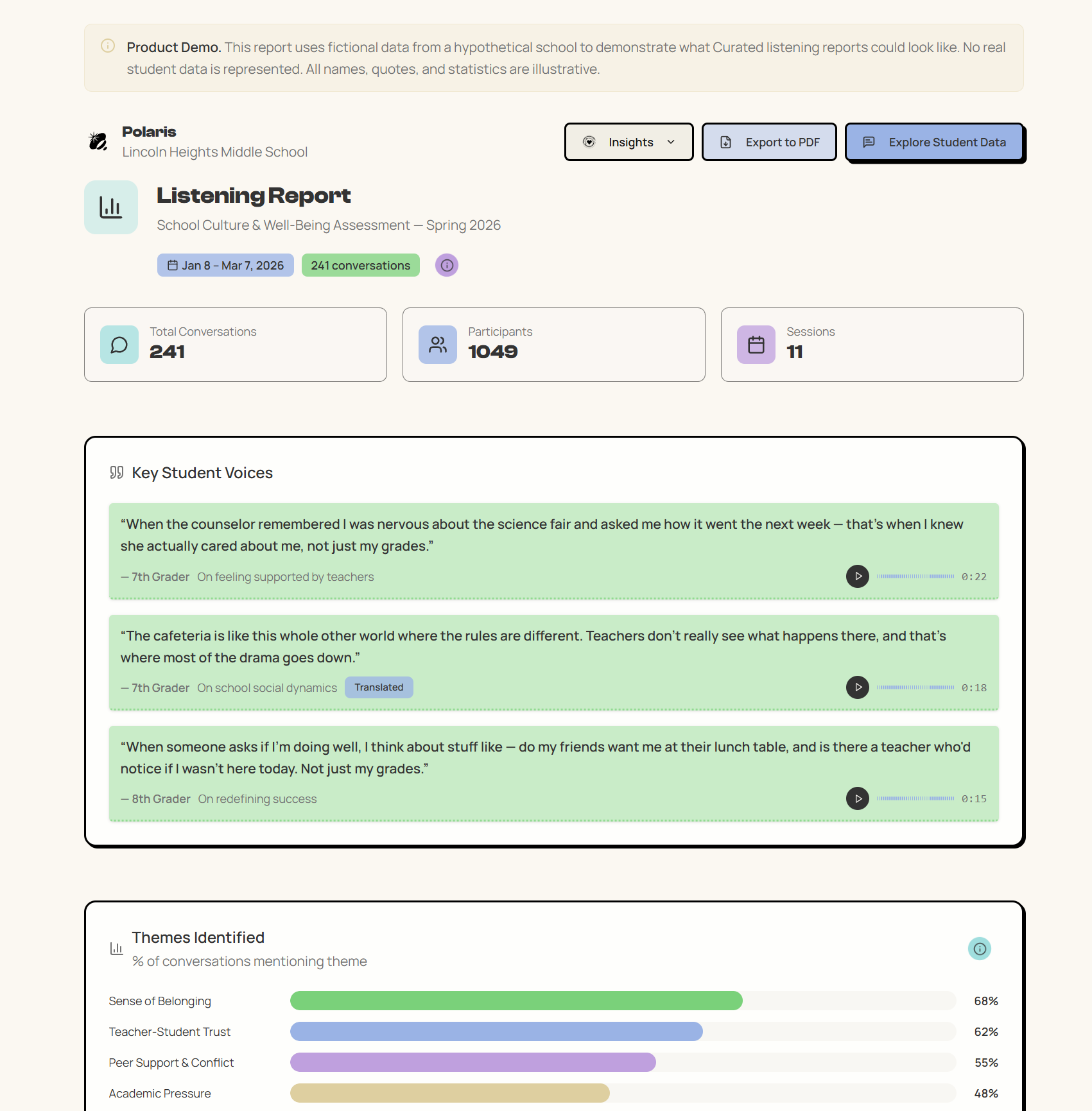
report
facilitating empathy interviews
listen
Create a welcoming and fair space for everyone.
What does it look like or sound like to be a good listener?
What does it look like or sound like to create a welcoming, fair space for everyone?
What does a good facilitator do?
5 key ideas
step up, step back
listen respectfully
disagree kindly
take your time
don't name specific people
step up · listen respectfully
step up, step back
Ensure everyone is heard.
listen respectfully
Speak and listen with respect. What does this look like as a facilitator?
disagree kindly · take your time
disagree kindly
Invite differing opinions, not just positive/negative "vibes."
take your time
Allow for silence and reflection. What does this look like as a facilitator?
don't name specific people
If a peer names someone, simply remind them of the norm and have them restate the idea.
Generic descriptions are totally fine! ("My 9th grade teacher…") We don't collect names; this applies to all feedback.
derailment
If someone attempts to derail the conversation…
- Attempt to move on; remind them of the purpose of the conversation.
- (If needed) dismiss a peer and report after the conversation.
uncomfortable statements
Make a note of what this student says.
when to report?
If a peer says any of the following, email connect@humanrestorationproject.org (and tell your conversation coordinator/teacher) as soon as the conversation finishes. This isn't anticipated, but if they do…
- Harm toward themselves or others, or someone is harming them
- Discrimination (e.g. racism, sexism)
- Crimes / vandalizing / drug use / fights
key ideas
- Step up, step back: ensure everyone is heard
- Listen respectfully: speak and listen with respect
- Disagree kindly: invite differing opinions
- Take your time: allow for silence and reflection
- Privacy & confidentiality: don't name specific people
Outlier scenarios: derailment (move on, remind of purpose; dismiss & report if needed) and uncomfortable statements (validate → mitigate → resolve). Report harm, discrimination, or crimes.

access the resources
go to
roleplay scenarios

roleplay scenarios
Act out, have rich conversations, and conflict resolve.
demonstration
- Sharing more
- Silence
- Disruption
- Positive / negative "vibes"
roleplay cards
Groups of 3, feel free to skip cards! One facilitator card, paired peer card.
reflection
- What were the biggest challenges you faced? What challenges do you anticipate?
- What was your comfort level with leading a conversation? How did it feel?
- What questions do you have regarding facilitation?
question co-creation
In groups of 2–3:
- What topics/ideas does our school need more information about?
- What questions can elicit meaningful responses on this information?
- Propose 3 questions: voting will occur in multiple rounds for top answers.
- Narrow down to 3–4 questions total for the school.

tech setup
tech setup
- Navigate to polariseducation.ai and click "Sign Up" in the top right.
- Create an account using Google.
- Select that you're a student, fill out your name, and choose Michigan DOE. Use code: 2461
- Create a test recording and confirm the audio waveform is moving. This does not need to be submitted.
- Email us if you run into any difficulties with your recording.
For virtual recording, specific instructions to record on Google Meet (e.g. a Google Meet plugin) will be shared closer to the date.
practice run!

practice questions
To get started and test the recording, share what grade you're in and your favorite subject (if you have one).
- What was one thing about this school year that you didn't expect?
- What was something you did this year that you found engaging (as in, interesting and it drew you in)?
- What's something you'd want teachers to know to improve last year? What should we change?
- What's something that you think your peers really need to talk more about in school? Why?
final thoughts?
Human Restoration Project · connect@humanrestorationproject.org